
Financial Statements: Analyze and Advise
CPE for CPAs: deepen financial-statement analysis and turn accounting information into better business advice.
Practical CPE for accounting professionals
Move beyond reading the statements to explaining what they mean for a business. This on-demand CPE course helps CPAs connect financial performance, working capital, financing and cash flow with the questions clients and management ask.
What you will work on
- Connect the income statement, balance sheet and cash flow statement.
- Interpret profitability, liquidity, leverage and coverage measures.
- Analyze operating working capital and cash-conversion effects.
- Explain how assets, financing and accounting choices affect the financial picture.
Who this course is for
CPAs and accounting professionals who use financial statements in analysis and advisory work. Familiarity with the basic purpose and structure of the primary financial statements is required.
Fit CPE learning around your work
Learn on demand and apply the material through the course activities. Review the CPE program details and completion requirements before enrolling. Credit is earned through successful completion, not purchase alone; acceptance is determined by your state board.
Choose practical CPE you can apply in your next analysis, report or client conversation.
CPE program details
Field of study: Accounting — Technical
Program level: Advanced
Delivery method: QAS Self Study
Prerequisites: Familiarity with the basic purpose and structure of the primary financial statements.
Advance preparation: None.
Credit and completion: 6.6 CPE hours. Complete all required content and reinforcement activities and score at least 70% on the final assessment. A downloadable certificate is issued after successful completion.
Registration and access: Create or sign in to a Pillars account and complete enrollment or purchase. Individual self-study access expires 365 days after enrollment.
Refunds, cancellations, and complaints: Review the Terms & Conditions. Submit program or service complaints through Pillars Support.
Learning objectives
- Locate and use annual-report components and distinguish US GAAP from IFRS reporting context.
- Explain the purpose, time dimension, accounting equation, and links among the three financial statements.
- Apply accrual accounting, revenue recognition, matching, deferrals, prepayments, and accruals to transactions.
- Classify operating and non-operating items and calculate EBIT, EBITDA, and normalized measures.
- Calculate and interpret tax, earnings per-share, margin, return, leverage, and coverage metrics.
- Classify current operating accounts and calculate working-capital and liquidity measures.
- Calculate operating working capital, days ratios, and cash-conversion-cycle effects.
- Prepare and interpret PP&E and intangible-asset roll-forwards.
- Analyze debt, equity, net debt, invested capital, leverage, and coverage.
- Explain major equity accounts and roll retained earnings through net income and dividends.
- Construct and reconcile a cash flow statement and classify operating, investing, and financing flows.
Pillars of Wall Street LLC is registered with the National Association of State Boards of Accountancy (NASBA) as a sponsor of continuing professional education on the National Registry of CPE Sponsors (Registry ID 122036). State boards of accountancy have final authority on the acceptance of individual courses for CPE credit. Complaints regarding registered sponsors may be submitted to the National Registry of CPE Sponsors through its website.
Understand what the numbers are telling you
Strengthen the analysis behind your advice. Examine financial performance, liquidity and cash generation through the questions CPAs face in client and management conversations.
Use the interactive lessons and practice to connect accounting knowledge with business insight. Familiarity with the basic purpose and structure of financial statements is required.
Your learning path
On demand — work through the material in sequence, at your own pace.
Six subject sections — statements, performance, working capital, assets, financing and cash flow.
Practice and assessment — reinforcement throughout, followed by a final assessment and program evaluation.
6.6 CPE credits — complete the requirements and achieve at least 70% on the final assessment.
Make the statements work together
- Connect the income statement, balance sheet and cash flow statement.
- Interpret earnings, margins, returns and coverage measures.
- Assess liquidity, operating working capital and cash conversion.
- Understand the effects of long-term assets, debt and equity.
- Reconcile cash flows and distinguish operating, investing and financing activity.
Apply each idea through the course’s interactive lessons and reinforcement activities.

Your course, section by section
01 · Financial-statement foundations
Explore annual-report components, the accounting equation, the three primary statements and how they connect. Complete the accompanying reinforcement quiz.
02 · The income statement
Work through accrual accounting, revenue and expense recognition, operating performance, earnings measures and profitability. Reinforce the concepts with the section quiz.
03 · Working capital
Analyze current operating accounts, liquidity, operating working capital, days ratios and the cash-conversion cycle. Apply the concepts in the accompanying quiz.
04 · Non-current assets
Interpret long-term assets, PP&E and intangible-asset roll-forwards, goodwill, impairment concepts and investment classifications. Complete the section reinforcement.
05 · Debt and equity
Examine debt, leases, equity accounts, retained earnings, net debt, leverage and coverage. Use the section quiz to check understanding.
06 · The cash flow statement
Construct and reconcile cash flows and distinguish operating, investing and financing activities. Complete the final subject-section quiz.
Assessment and completion
The course includes a pre-assessment, six learning sections and their reinforcement quizzes, a final assessment and a required program evaluation: 15 activities in total. Complete the required content in sequence and score at least 70% on the final assessment.
A record of what you have achieved
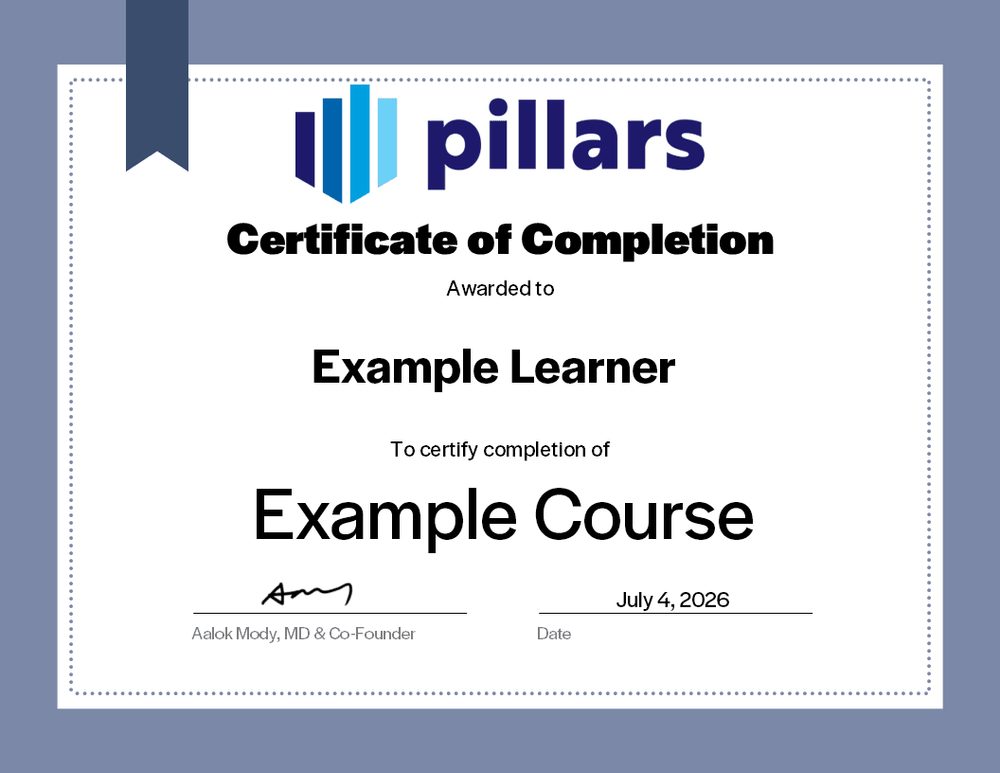
Complete the required learning activities, pass the final assessment with a score of at least 70%, and submit the program evaluation. Your downloadable completion certificate records the course and its 6.6 CPE credits.
The image is an illustrative Pillars certificate, not an issued credential. Individual state boards have final authority on acceptance of CPE credit.
Common questions
Is this live or on demand?
This is an on-demand, self-study course. You complete the learning activities online in sequence, rather than attending a scheduled instructor-led session.
Who is this course for?
CPAs and accounting professionals who want to strengthen financial-statement analysis for client advice, management discussions or corporate finance. The authored CPE program level is Advanced; familiarity with the basic purpose and structure of the primary financial statements is a prerequisite. No advance preparation is required.
How do I earn the CPE credit?
Complete the required course content and reinforcement activities, score at least 70% on the final assessment, and submit the program evaluation. The configured award is 6.6 CPE credits. State boards have final authority on accepting individual courses.
How long do I have access, and where can I get help?
Individual self-study access expires 365 days after enrollment. For help, use Pillars Support. Review Terms & Conditions for refund and cancellation information.
Build stronger financial judgment
Make your next CPE course relevant to the work in front of you. Use the enrollment button at the top of this page to begin.
Planning CPE for an accounting firm or finance team? Talk with Pillars about training aligned with your team’s work and experience.