
Advanced DCF Modeling
Extend the DCF for non-operating assets, synergies, stub periods, and multi-stage terminal value.
Handle the DCF issues that simple templates miss
Advanced DCF work requires more than applying a terminal multiple to a forecast. This live course addresses non-operating assets and liabilities, synergies, stub periods, mid-year discounting, implied terminal metrics, and multi-stage steady-state assumptions so participants can model complex valuation situations without losing the economic logic.
The session at a glance
Format · Live instructor-led webinar or in person Learning objectives · Model stub periods and mid-year discounting, incorporate non-operating assets and liabilities, value synergies, interpret implied terminal metrics, and build a multi-stage steady-state DCF.
Live instruction. Advanced DCF judgment.
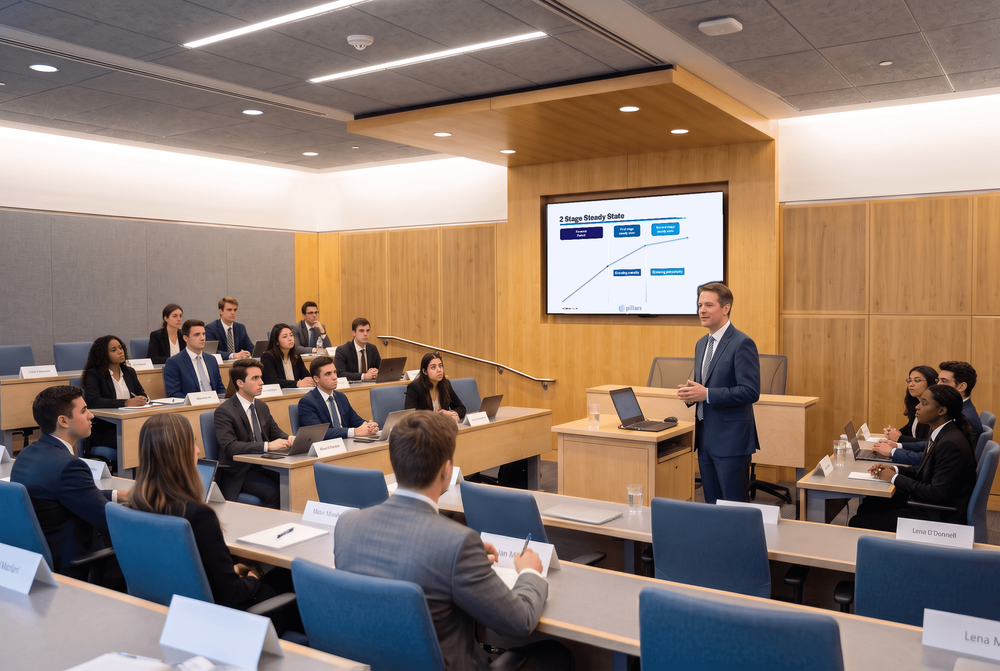
Build beyond the standard DCF with guided examples that isolate the effect of timing, non-operating claims, synergies, and multi-stage steady-state assumptions. The session shows how to preserve model integrity when the valuation becomes more complex.

Who this course is for
Designed for experienced analysts, associates, valuation professionals, corporate-development teams, and investors who already understand core DCF mechanics and need to address more complex situations.
Preparation that makes the advanced work more useful
Bring a working DCF, a recent valuation case, or a complex adjustment you would like to understand more clearly. Participants should be comfortable with unlevered free cash flow, WACC, terminal value, and the enterprise-to-equity bridge before the session.
Course agenda
Extend a core DCF to timing, ownership, synergy, and multi-stage valuation issues.
Refine the timing conventions
We model stub periods and mid-year discounting and ensure forecast cash flows and terminal value are timed consistently.
Incorporate non-operating assets and liabilities
We evaluate cash, investments, debt-like claims, noncontrolling interests, preferred stock, and other enterprise-to-equity adjustments.
Value transaction synergies
We calculate synergy cash flows, determine how they affect terminal value, and separate them from standalone value.
Interpret implied terminal assumptions
We calculate implied perpetuity growth rates and exit multiples and use them to challenge the valuation conclusion.
Build a multi-stage steady-state DCF
We close by modeling businesses whose growth, margins, or reinvestment normalize across more than one terminal stage.
A certificate worth sharing
Upon completion, you will receive a certificate signifying your completion. Add it to your LinkedIn profile, résumé, or professional-development record.
Common questions
The practical details, in one place.
Is this live or on demand?
This is a live, instructor-led course delivered as a webinar or in person for a private business or school group.
What does the session cover?
The session covers stub periods, mid-year discounting, non-operating assets and liabilities, transaction synergies, implied terminal metrics, and multi-stage steady-state DCFs.
Are recordings, materials, or certificates included?
Live sessions include the materials used during the program and a certificate of completion. Recordings are not included unless explicitly arranged in advance.
I am a CPA, can this course offer CPE credit?
Yes. Eligible live sessions can be offered for CPE credit when the program is delivered and documented in accordance with Pillars’ CPE policies. Confirm the specific engagement details with Pillars before the session.
Bring advanced DCF modeling to your team.
Give your valuation team a disciplined framework for handling the DCF issues that standard templates miss.