
Debt Capital Markets Overview
Understand debt markets, fixed-income instruments, bond math, pricing, yield, duration, and convexity.
How debt moves from issuer to investor
Debt capital markets connect organizations seeking funding with investors seeking income, liquidity, and risk-adjusted return. This session builds the market framework before turning to the financial math professionals use to interpret bonds.
Participants connect issuance and trading activity to price, yield, cash flow, duration, and convexity.
The session at a glance
Format · Live instructor-led webinar or in-person
Focus · Market structure, fixed-income instruments, bond math, price and yield
Learning objectives · Explain how debt securities are issued, valued, compared, and discussed in professional finance settings.
Live instruction. Real market context.
What to expect
- A practical tour of primary issuance, secondary trading, and the participants connecting both markets.
- Clear explanations of bond structures, valuation inputs, and the relationships among price, yield, duration, and convexity.
- Calculator-friendly examples that reinforce professional judgment without requiring a complex model.
The goal is to understand both the market story and the math behind a fixed-income conclusion.


Who this is for
- Analysts and associates working with corporate finance, treasury, banking, or investing teams
- Accountants and finance professionals who need a stronger fixed-income foundation
- Teams that evaluate funding alternatives or communicate with debt-market professionals
- Students preparing for capital-markets or credit-oriented roles
How to prepare
A basic understanding of financial statements and time value of money is helpful, but advanced fixed-income experience is not required.
Bring a calculator and be ready to work through compact examples. The emphasis is on interpreting the result and communicating what it means—not memorizing formulas without context.
Course agenda
Five connected topics move from market structure to the interpretation of bond value and risk.
Build the debt-capital-markets framework.
Explain how primary and secondary markets operate and how issuers, investors, dealers, and Treasury securities fit within the broader system.
Identify the cash flows and terms of a fixed-income security.
Read principal, coupon, maturity, frequency, and market conventions so that the economics of a security are clear before any calculation begins.
Apply present value to zero-coupon and coupon bonds.
Use time-value-of-money concepts and manageable calculations to connect promised cash flows with a bond’s value.
Compare price, yield, and holding-period measures.
Distinguish coupon rate, current yield, yield to maturity, and holding-period yield, and explain why price and yield move in opposite directions.
Interpret duration and convexity as measures of sensitivity.
Describe how duration and convexity help frame interest-rate exposure while recognizing the assumptions and limits behind those measures.
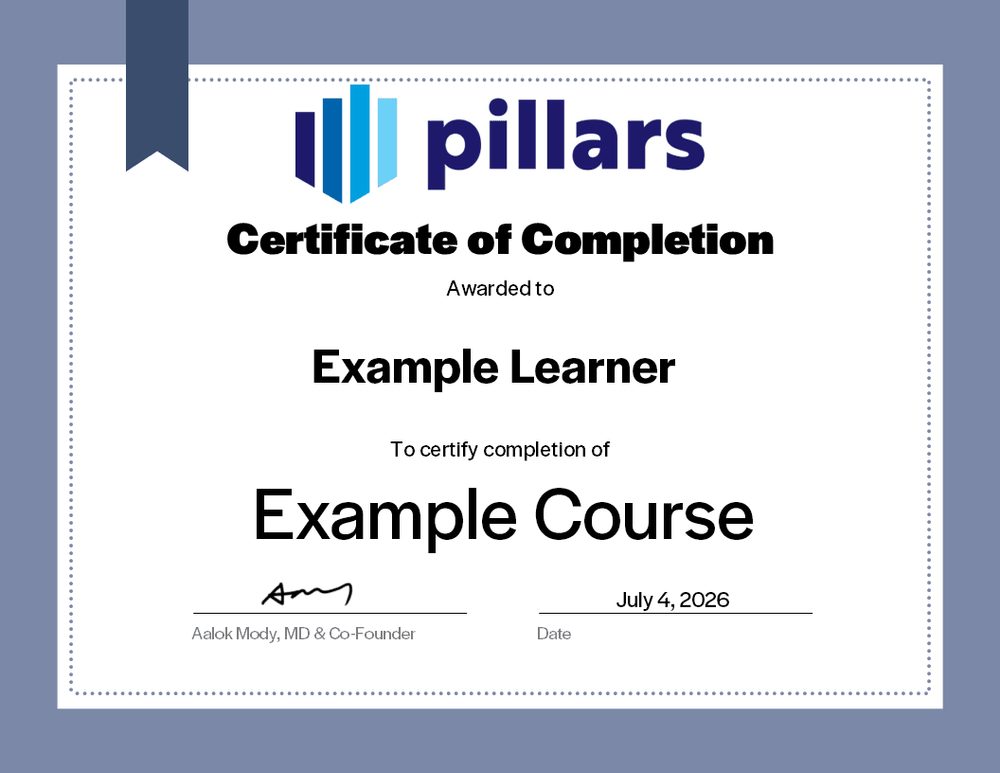
A certificate you can share
Upon completion, you will receive a certificate signifying your completion. Add it to your LinkedIn profile, résumé, or professional-development record.
Common questions
The practical details, in one place.
Is this live or on demand?
This is a live course that may be delivered via webinar or in-person.
What does the session cover?
The session covers debt-market structure, fixed-income instruments, bond math, and the relationship between price and yield, including how debt securities are issued and valued.
Are recordings, materials, or certificates included?
Materials are included with the course as well as a certificate indicating completion. Recording availability is subject to contract.
I am a CPA, can this course offer CPE credit?
Yes! Pillars is licensed to provide CPE credit hours for this course.