
Hedge Funds
Understand how hedge funds are structured, how strategies differ, and where risk can hide.
Make sense of hedge fund structure and strategy
Overview · Outcomes · Audience · Agenda · Certificate · FAQ
Hedge funds combine flexible investment mandates with distinctive fee, liquidity, leverage, and governance structures. This live course gives participants a practical framework for comparing major strategies, understanding how returns are pursued, and evaluating the risks behind the label.
The session at a glance
Format · Live instructor-led webinar or in person
Learning objectives · Explain common hedge fund structures and economic terms; distinguish major equity, event-driven, relative-value, credit, and macro strategies; and evaluate leverage, liquidity, concentration, operational, and market risks without relying on performance claims.
Live instruction. Strategy, structure, and risk.
Use strategy maps, fund-term examples, and portfolio scenarios to compare how hedge funds seek returns and manage exposure. The instructor emphasizes the economic engine behind each strategy and the risk questions professionals should ask before drawing conclusions.


Who this course is for
Designed for finance professionals, allocators, accountants, analysts, investment teams, risk professionals, and client-facing professionals who need a practical understanding of hedge fund structures and strategies.
Preparation that sharpens the discussion
Bring a fund strategy, term sheet, due-diligence question, or risk concern you would like to interpret more clearly. No hedge fund investing experience is required; familiarity with basic securities and portfolio concepts is helpful.
Course agenda
Build from fund structure and economics to strategy families, exposures, and risk.
Establish the hedge fund structure
We begin with the manager, fund vehicle, investors, service providers, and the legal and operating relationships that support the strategy.
Interpret fees and liquidity terms
We examine management and incentive fees, high-water marks, hurdles, lockups, redemption terms, gates, and why those terms matter to investors.
Compare equity and event-driven strategies
We distinguish long-short, market-neutral, short-only, merger-arbitrage, distressed, and special-situations approaches by source of return and exposure.
Evaluate relative-value, credit, and macro strategies
We examine convertible arbitrage, fixed-income and credit relative value, and global macro strategies and the market relationships each relies on.
Connect strategy to risk
We close by assessing leverage, financing, liquidity, concentration, counterparty, model, and operational risks in the context of the stated investment approach.
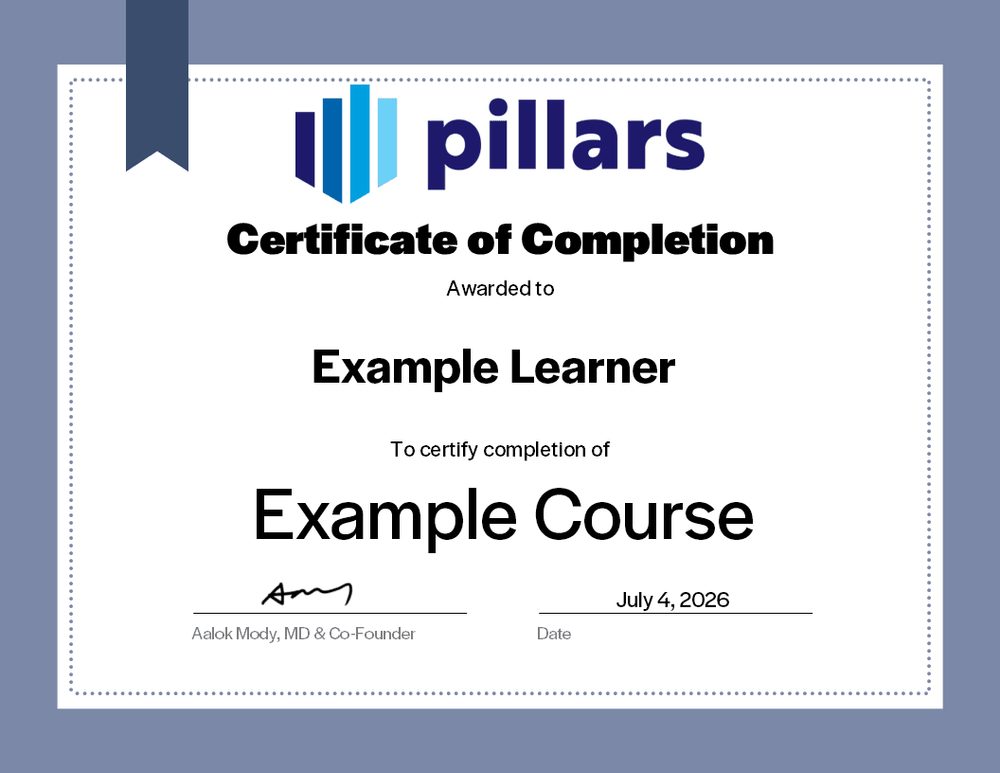
A certificate worth sharing
Upon completion, you will receive a certificate signifying your completion. Add it to your LinkedIn profile, résumé, or professional-development record.
Common questions
The practical details, in one place.
Is this live or on demand?
This is a live, instructor-led course delivered as a webinar or in person for a private business or school group.
What does the session cover?
The session covers hedge fund structure, fees, liquidity terms, equity, event-driven, relative-value, credit, and macro strategies, plus the principal risks associated with each.
Are recordings, materials, or certificates included?
Live sessions include the materials used during the program and a certificate of completion. Recordings are not included unless explicitly arranged in advance.
I am a CPA, can this course offer CPE credit?
Yes. Eligible live sessions can be offered for CPE credit when the program is delivered and documented in accordance with Pillars’ CPE policies. Confirm the specific engagement details with Pillars before the session.
Bring practical hedge fund training to your team.
Give your team a clearer framework for comparing fund structures, strategy economics, exposures, and risk.