
Introduction to Derivatives
Understand how options, forwards, futures, and swaps reshape financial exposure.
Build a practical framework for derivatives
Overview · Outcomes · Audience · Agenda · Certificate · FAQ
Derivatives let organizations transfer, reshape, and manage financial risk. This live course explains the core contract families—options, forwards, futures, and swaps—so participants can identify the underlying exposure, interpret the payoff, and understand why a transaction is used.
The session at a glance
Format · Live instructor-led webinar or in person Learning objectives · Distinguish options, forwards, futures, and swaps; explain forward commitments and contingent claims; interpret basic payoff structures; and evaluate common hedging, speculation, arbitrage, leverage, and counterparty-risk considerations.
Live instruction. See the structure behind the payoff.
Work through the major derivative families with diagrams, market examples, and plain-language payoff logic. The instructor connects contract terms to the exposure being transferred so participants can explain both the economic purpose and the risks of a position.


Who this course is for
Designed for finance professionals, analysts, accountants, treasury teams, risk professionals, and investment professionals who need a practical introduction to derivative instruments and their business uses.
Preparation that makes the session more useful
Bring a risk exposure or market transaction you would like to understand more clearly—such as an interest rate, currency, commodity, equity, or credit exposure. No derivatives modeling experience is required; familiarity with basic financial markets is helpful.
Course agenda
Move from contract structure to payoff, use case, and risk in a logical sequence.
Define derivatives and their building blocks
We begin with the underlying asset or exposure, the contract terms, and the distinction between a forward commitment and a contingent claim.
Compare forwards and futures
We examine customized and standardized contracts, settlement mechanics, exchange trading, margin, and counterparty considerations.
Understand swaps
We explain how parties exchange cash flows and connect common swap structures to interest-rate, currency, and other exposures.
Interpret options
We compare calls and puts, rights and obligations, premiums, moneyness, and the shape of basic option payoffs.
Apply derivatives responsibly
We close by distinguishing hedging, speculation, and arbitrage and by evaluating leverage, basis, liquidity, and counterparty risk.
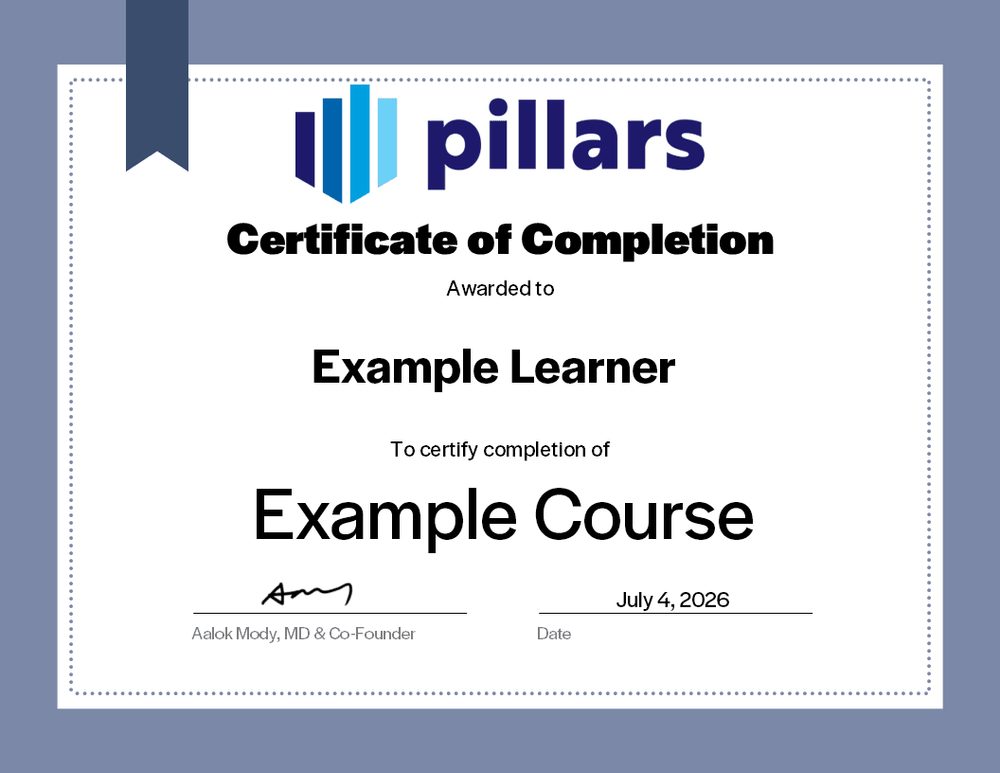
A certificate worth sharing
Upon completion, you will receive a certificate signifying your completion. Add it to your LinkedIn profile, résumé, or professional-development record.
Common questions
The practical details, in one place.
Is this live or on demand?
This is a live, instructor-led course delivered as a webinar or in person for a private business or school group.
What does the session cover?
The session covers options, forwards, futures, and swaps, including contract structure, payoff logic, exchange-traded versus over-the-counter markets, common use cases, and key risks.
Are recordings, materials, or certificates included?
Live sessions include the materials used during the program and a certificate of completion. Recordings are not included unless explicitly arranged in advance.
I am a CPA, can this course offer CPE credit?
Yes. Eligible live sessions can be offered for CPE credit when the program is delivered and documented in accordance with Pillars’ CPE policies. Confirm the specific engagement details with Pillars before the session.
Bring practical derivatives training to your team.
Give your team a shared framework for explaining derivative contracts, payoff structures, business uses, and risk.