
IPO Modeling & Valuation
Connect IPO proceeds, ownership, dilution, and valuation in one defensible model.
Model the economics of an IPO from proceeds to public value
Overview · Outcomes · Audience · Agenda · Certificate · FAQ
An IPO changes a company’s capital structure, ownership, expenses, and valuation context at the same time. This live course shows how to organize those moving pieces in a clear model that connects offering assumptions to capitalization, per-share value, dilution, and the fully distributed valuation range.
The session at a glance
Format · Live instructor-led webinar or in person
Learning objectives · Distinguish primary and secondary shares; calculate gross and net proceeds; model offering expenses and post-IPO capital structure; adjust public-company operating assumptions; and translate valuation multiples and an IPO discount into a fully distributed price range.
Live instruction. From proceeds to public value.
Work through the complete IPO bridge—from offer assumptions and transaction expenses to post-IPO capitalization and the fully distributed valuation range. The instructor emphasizes model structure, transaction logic, and the checks that keep share counts, proceeds, ownership, and value consistent.


Who this course is for
Designed for investment banking, corporate finance, equity-capital-markets, valuation, accounting, and transaction professionals who need to understand or review IPO models and offering economics.
Preparation that improves the modeling discussion
Bring an IPO filing, capitalization question, valuation range, or transaction assumption you would like to understand more clearly. Familiarity with basic financial statements and valuation multiples is helpful; no completed IPO model is required before the session.
Course agenda
Follow the IPO model in the same order the transaction economics develop.
Establish the offering assumptions
We begin with primary and secondary shares, offer size, indicative price range, underwriting fees, expenses, and the intended use of proceeds.
Calculate gross and net proceeds
We connect share counts and pricing to gross proceeds, fees, expenses, company cash, debt paydown, and selling-shareholder proceeds.
Build the post-IPO capitalization
We model basic and fully diluted shares, options and other securities, net debt, cash, ownership, and the bridge from enterprise value to equity value.
Adjust the public-company operating case
We reflect recurring public-company costs, financing effects, taxes, and other forecast changes created by the transaction.
Derive and test the valuation range
We apply selected multiples and an IPO discount, calculate the fully distributed price range, and test sensitivity to price, share count, dilution, and ownership assumptions.
A certificate worth sharing
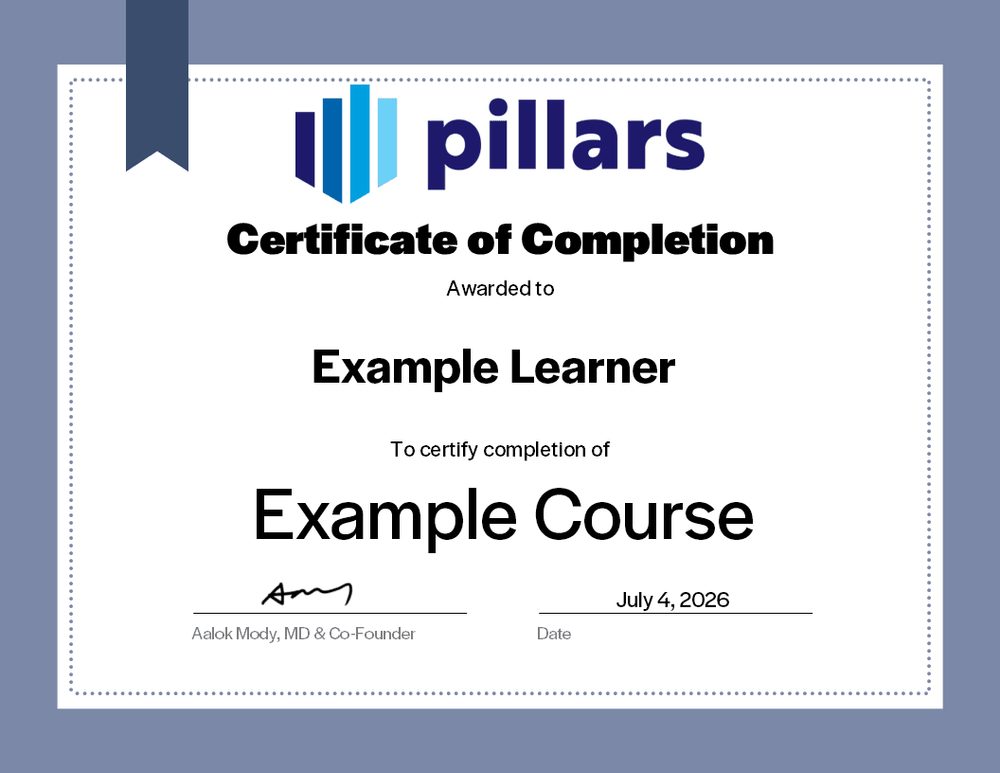
Upon completion, you will receive a certificate signifying your completion. Add it to your LinkedIn profile, résumé, or professional-development record.
Common questions
The practical details, in one place.
Is this live or on demand?
This is a live, instructor-led course delivered as a webinar or in person for a private business or school group.
What does the session cover?
The session covers primary and secondary shares, proceeds and expenses, post-IPO capitalization, public-company forecast adjustments, ownership and dilution, and the fully distributed valuation range.
Are recordings, materials, or certificates included?
Live sessions include the materials used during the program and a certificate of completion. Recordings are not included unless explicitly arranged in advance.
I am a CPA, can this course offer CPE credit?
Yes. Eligible live sessions can be offered for CPE credit when the program is delivered and documented in accordance with Pillars’ CPE policies. Confirm the specific engagement details with Pillars before the session.
Bring practical IPO modeling training to your team.
Give your team a repeatable way to connect offering assumptions, proceeds, capitalization, dilution, and valuation in one transaction model.